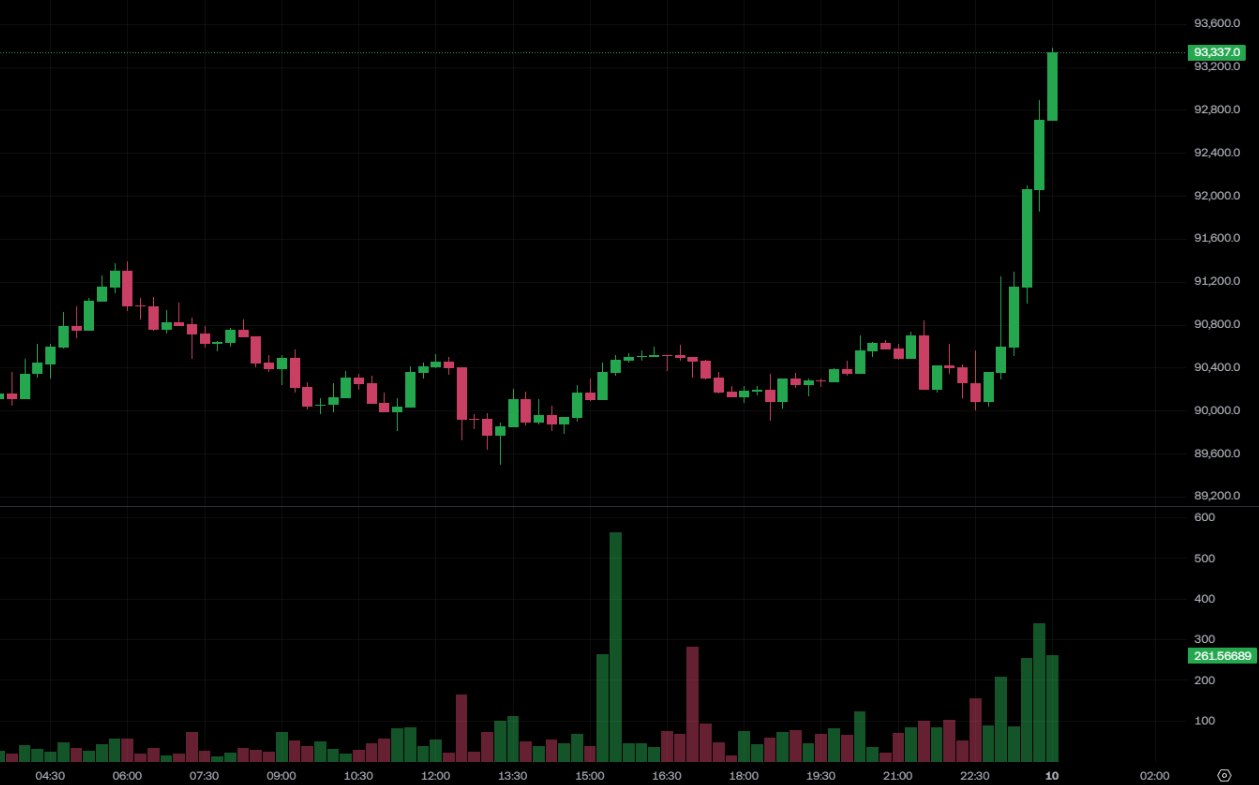
The U.S. Office of the Comptroller of the Currency opens banks to “match” cryptocurrency transactions! Bitcoin surges above $93,000, Ethereum stands at $3,200
The U.S. Office of the Comptroller of the Currency (OCC) officially issued Interpretive Letter 1188 today (9th), clearly confirming that national banks can legally engage in "riskless principal transactions" of crypto assets under certain conditions.
(Previous summary: The U.S. CFTC announced the release of BTC, ETH, and USDC as margins and collateral for derivatives contracts)
(Background supplement: U.S. SEC Chairman Paul Atkins: Tokenization and digital assets will fully enter the financial system "faster than everyone expects")
Contents of this article
Office of the Comptroller of the Currency (Office of the Comptroller of the Currency (OCC) officially issued Interpretive Letter 1188 today (9th), clearly confirming that national banks can legally engage in "riskless principal transactions" of crypto assets under certain conditions.
This will allow the bank to act as a "risk-neutral" principal and conduct equal amounts of reverse transactions with two customers at the same time without holding any crypto assets. The function is equivalent to that of a traditional broker. It can be called the most important step in the policy of US regulators to loosen restrictions on banks' participation in the crypto market.
Look at the three core points of Letter No. 1188 at once
Completely hedging and leaving no inventory
The bank can buy (or sell) a certain amount of crypto assets such as Bitcoin and Ethereum with Customer A, and at the same time immediately conduct transactions of the same amount and in the opposite direction with Customer B, achieving "second hedging" and always having "zero positions" on the bank account, completely avoiding the risk of price fluctuations.
Equivalent to agency brokerage business
OCC clearly believes that this model is essentially "agency matching" and is an "incidental power" permitted by the National Bank Law, and banks can operate it without applying for additional special licenses.
Safety and soundness are still the iron rule
Although the green light is given, banks must establish complete anti-money laundering (AML), information security, and third-party risk management mechanisms, and notify the OCC competent authority in advance, otherwise they may still face regulatory sanctions.
This guidance is equivalent to officially opening the door for giants such as JPMorgan Chase, Bank of America, and Goldman Sachs, allowing traditional banks to directly provide customers with spot matching services for Bitcoin and Ethereum in a "low-risk" manner.
The market responded enthusiastically, and Bitcoin broke through the US$93,000 mark
After the news was released, Bitcoin (BTC) quickly rose to exceed US$93,000; Ethereum (ETH) rose simultaneously, reaching US$3,200 in one fell swoop.